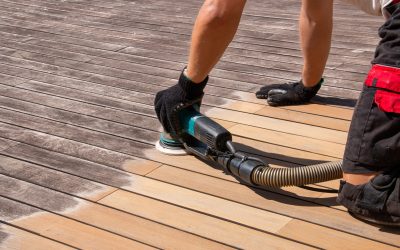
School floor sanding in Clapham SW4
School floor sanding in Clapham SW4 needs more planning than an ordinary domestic floor renovation. In busy primary schools, nurseries, colleges and educational buildings, timber floors take a daily pounding from classroom furniture, muddy footwear, cleaning chemicals and constant foot traffic. Once the protective seal starts breaking down, dirt works into the grain, exposed boards absorb moisture, and damaged surfaces become harder to clean and potentially unsafe for pupils and staff.
At Clapham Floor Sanding, we understand that shutting a classroom or school hall for several days is rarely straightforward. Whether you manage a Victorian school conversion near Clapham Common, an Edwardian institutional building off Clapham High Street or a modern educational facility around Clapham North, the work needs to fit around safeguarding arrangements, teaching hours, cleaners and other contractors. Our approach to School Floor Restoration in Clapham is to establish what the timber needs, agree the access arrangements and choose a finishing system that will stand up to its actual use.
Not every worn school floor needs stripping back to bare wood. Some surfaces can be cleaned, mechanically abraded and recoated, while others require board repairs and complete School Floor Refinishing in Clapham. We also advise on School Floor maintenance in Clapham, helping education managers extend the life of existing timber without paying for unnecessary sanding.
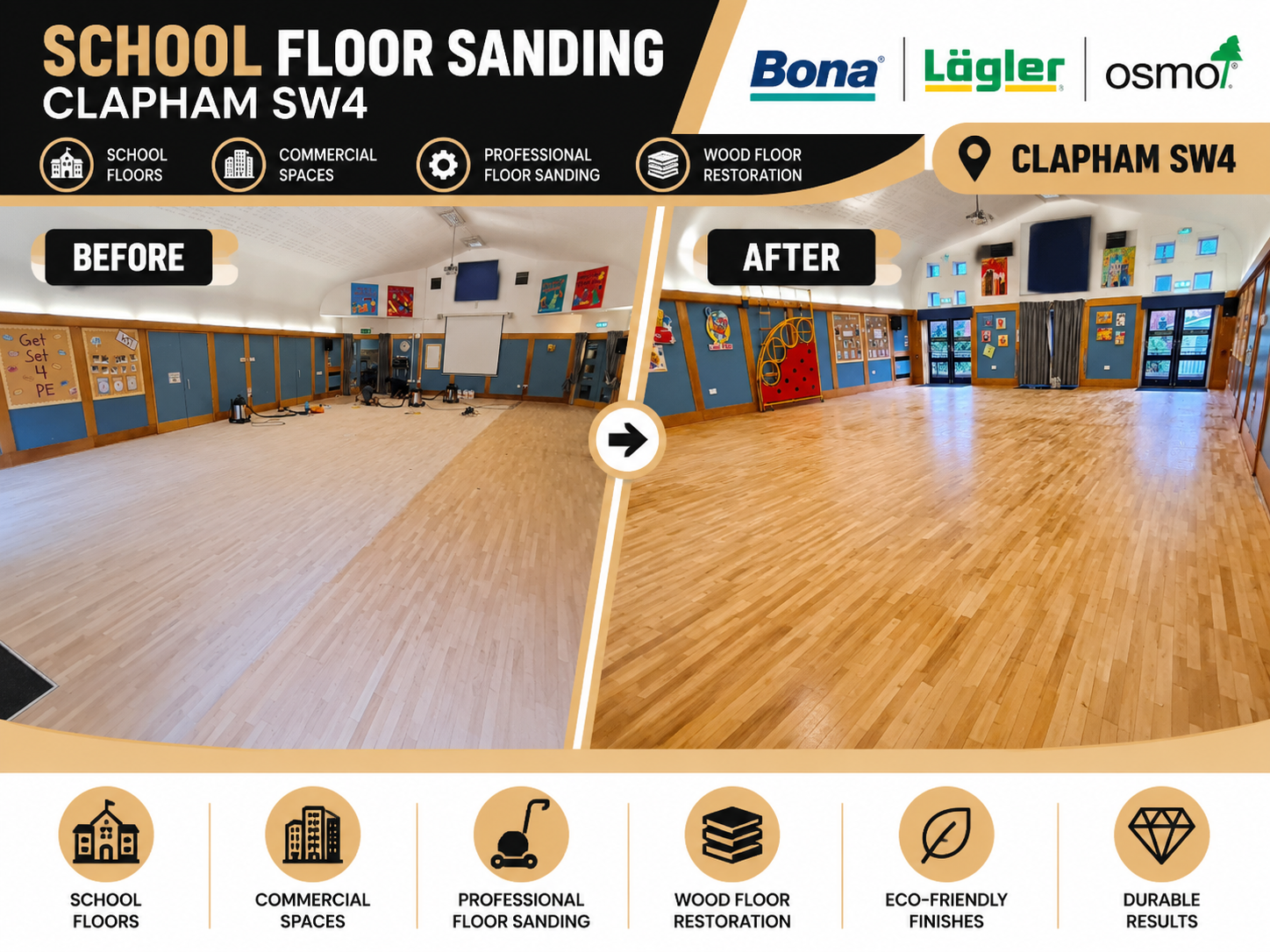
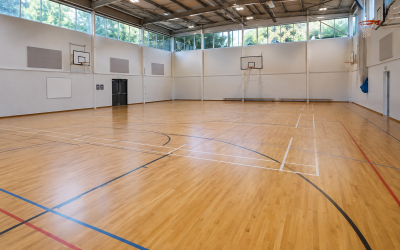
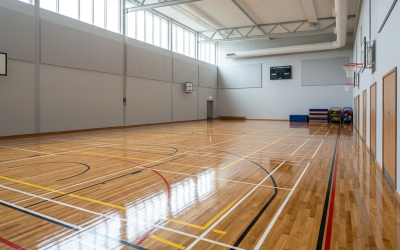
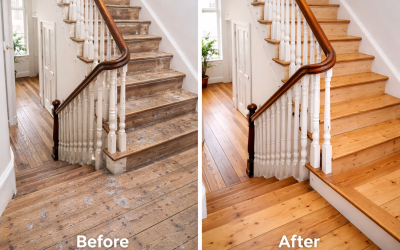
School floor sanding and restoration in Clapham, SW4. Our before-and-after project showcases the transformation of a timber school hall floor, restoring its natural wood appearance and creating a refreshed, professional finish.
School Floor Restoration for Clapham’s Educational Buildings
Timber flooring in a school has a different working life from flooring in a private house. A domestic sitting room might see a handful of people each day; a school corridor can take hundreds of footsteps between morning registration and the final bell. Add wheeled storage units, dining tables, classroom chairs and regular wet cleaning, and the finish can wear through well before the timber itself reaches the end of its useful life.
Across SW4, older educational premises often contain suspended timber floors, traditional tongue-and-groove boards or solid parquet laid over earlier subfloors. Victorian conversions around Clapham Old Town and Edwardian institutional blocks near Clapham Common can present uneven joists, previous patch repairs and layers of historic coatings. These need proper investigation before anyone puts a belt sander across them.
We consider restoration requirements for a wide range of educational premises, including:
- Nurseries, preschools, Montessori schools and daycare centres: Smooth, easily cleaned floors suitable for crawling, play activities and frequent spillages.
- Primary and secondary schools: Durable classroom, corridor, assembly hall and dining area finishes capable of handling heavy daily wear.
- Independent, private, boarding and international schools: Sensitive restoration of older hardwood, strip flooring and parquet without unnecessarily changing the building’s original character.
- Academies, sixth-form colleges and further education facilities: Phased refurbishment of classrooms, common rooms, teaching spaces and circulation areas.
- SEND and specialist educational settings: Careful consideration of surface transitions, mobility equipment, sensory requirements and safe access.
- Universities, technical institutes and adult learning centres: Commercial-grade finishes for teaching rooms, lecture spaces, libraries and shared facilities.
- Music schools, dance studios, sports academies and performance spaces: Timber restoration with attention to the specialist slip, grip and movement requirements of each activity.
- Tuition centres, language schools, after-school clubs and childcare facilities: Out-of-hours refurbishment arranged around teaching schedules and safeguarding restrictions.
Why School Timber Floors Wear Out Faster Than Domestic Floors
One mistake we see with heavily used timber flooring is repeated application of supermarket polish over a failing lacquer. It may improve the shine temporarily, but it does nothing to repair an exposed joint, stabilise a loose parquet block or reinstate the original protective coating. Certain polish residues also contain waxes or silicones that interfere with the adhesion of subsequent professional lacquers.
Heavy commercial cleaning is another issue. Strong alkaline detergents, excessive water and unsuitable disinfectants can weaken certain finishes over time, particularly where the coating has already been scratched through. A floor can look reasonably clean after mopping while the exposed timber underneath is gradually darkening and deteriorating.
Common Structural and Safety Problems
- Open joints and dirt traps: Gaps between boards collect grit, food debris and cleaning moisture, making routine hygiene more difficult.
- Raised parquet blocks: Failed adhesive beds allow individual blocks to rock, lift or develop hazardous edges.
- Splinters and exposed fixings: Worn floorboards may expose nail heads or fractured timber, particularly around thresholds and furniture routes.
- Moisture ingress: Failed seals around entrances, sinks and wet-cleaned areas can lead to cupping, staining and timber movement.
- Variable slip resistance: Patchy lacquer, unsuitable polishing products and wet contamination can alter grip across the same floor.
- Uneven historic repairs: Replacement boards of different thicknesses can create level changes and localised sanding problems.
- Reduced remaining sanding depth: Older tongue-and-groove floors may have been sanded repeatedly, leaving insufficient timber above the joint.
Before specifying work for a school or public facility, we consider the surface’s slip-risk assessment. The traditional BS 7976-2 pendulum method remains familiar from older specifications, while BS EN 16165:2021 Annex C is the current reference for pendulum testing. Where documented slip performance is required, an appropriate independent test should establish the Pendulum Test Value under the relevant dry and wet conditions.
A PTV of 36 or above is commonly used as a benchmark for low slip potential under the tested conditions, but it is not a universal guarantee against slipping. The intended activity, footwear, contamination risk and cleaning regime all matter. A dance studio, for example, should not automatically receive the same surface specification as a school dining hall.
Our Step-by-Step Commercial School Floor Sanding Process
The quality of a school floor restoration is largely decided before the first sanding belt touches the boards. We look at the timber species, the condition of the original installation, existing coatings, moisture readings and the amount of time the facility can be taken out of use. That information determines whether the sensible option is local repair, a maintenance recoat or a full restoration.
Step 1: Subfloor Audit, Timber Identification and Moisture Testing
We begin by checking the floor’s construction and identifying the timber where reasonably possible. Older Clapham buildings may have pitch pine floorboards, oak strip flooring or hardwood parquet; some specialist areas contain dense tropical hardwoods such as teak. Quartersawn oak behaves differently from flatsawn softwood, while resin-rich pitch pine needs particular care when choosing abrasives, fillers and coatings.
Moisture assessment is essential where boards are cupped, parquet has lifted or a previous finish has failed prematurely. We use suitable timber moisture measurements and, where a concrete or screeded substrate is involved, consider in-situ hygrometer checks and the applicable requirements of BS 8201. Sanding a damp floor and sealing it immediately can trap an unresolved problem beneath a new coating.
We also check loose boards, fixing positions, joist movement, hollow-sounding parquet and old adhesive residues. Where historic coverings or suspicious materials are encountered, the necessary asbestos information and building records should be checked before disturbance. Any structural issue outside the scope of normal flooring repairs needs resolving before finishing work proceeds.
Step 2: Timber Repairs, Parquet Re-bonding and Resin Gap-Filling
Loose boards are secured, protruding fixings are dealt with and damaged timber is repaired or replaced using compatible material. Where sections of original pitch pine or oak remain serviceable, we generally favour retaining them rather than replacing whole areas unnecessarily. The objective is a sound, level substrate, not simply a floor that photographs well after lacquering.
With parquet floors, failed blocks are lifted carefully, the adhesive bed is cleaned and suitable replacement blocks are fitted where required. Depending on the substrate and system specification, silane-based flexible parquet adhesives can provide a strong bond while accommodating normal timber movement. The adhesive’s compatibility with the existing construction and its curing requirements must be checked before sanding.
For suitable small, stable joints, resin-slurry gap filling uses fine sanding dust combined with an appropriate binder to create a filler close to the floor’s natural colour. Wide or seasonally moving gaps need a different treatment, sometimes including timber slips, because a rigid filler can crack when boards expand and contract. We do not fill ventilation gaps, expansion allowances or moving joints simply to achieve a continuous-looking surface.
Step 3: HEPA Dust-Controlled Sanding and Surface Preparation
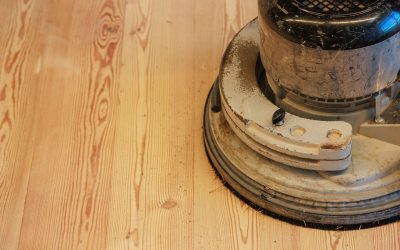
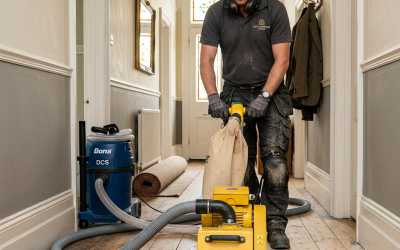
For substantial areas of solid timber, professional belt sanding equipment such as the Lägler HUMMEL offers controlled, consistent material removal. We select the abrasive sequence according to the existing finish, the timber species and the amount of wear. Aggressive sanding is not always appropriate, especially on older boards with limited remaining thickness above the tongue.
Edges, corners, thresholds and areas beneath fixed joinery require separate machines and hand finishing. Where practical, we combine extraction-equipped equipment with correctly maintained HEPA H14 filtration for fine dust control, alongside physical segregation of the work zone. H14 filtration is useful, but it does not make sanding literally dust-free or remove the need for cleaning and ventilation.
School projects require particular attention to dust migration. Before work begins, occupied areas should be separated from the sanding zone, nearby ventilation routes assessed, and doors and access points controlled. Fine timber dust is a respiratory and fire hazard, so the work plan must address suitable extraction, housekeeping, PPE and the relevant COSHH assessment.
The final sanding grades are chosen to suit the coating manufacturer’s instructions, rather than polished excessively fine for appearance alone. Poor surface preparation can reduce lacquer adhesion, while coarse scratches left by the previous abrasive remain visible once the finish has dried. We inspect the prepared timber under suitable lighting before applying the first coat.
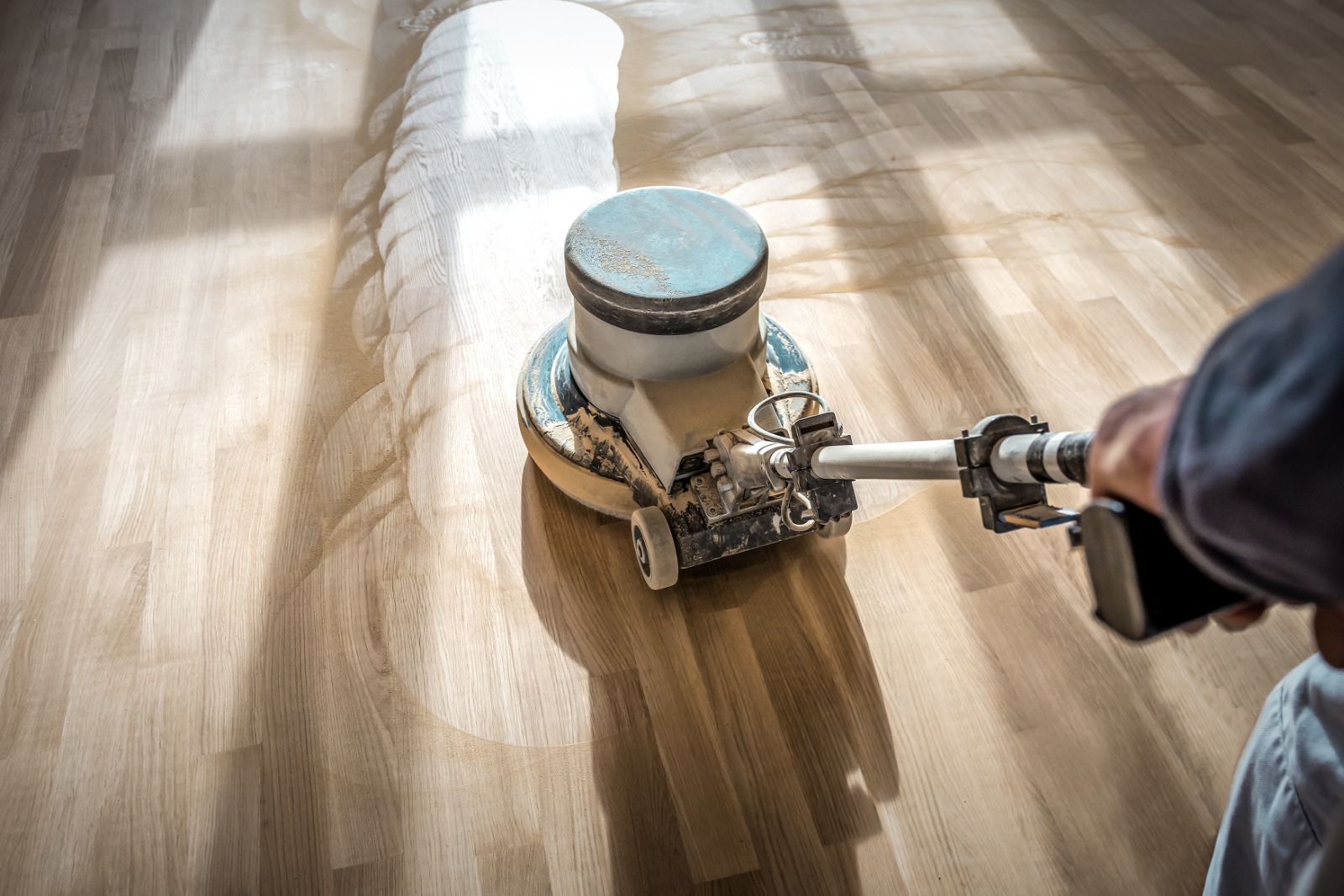
Step 4: High-Traffic Finishes, 2K Lacquers and Anti-Slip Options
For heavily used classrooms, corridors and halls, a properly specified two-component waterborne polyurethane lacquer is often a sensible choice. These systems combine the base lacquer with a measured cross-linking catalyst or hardener, improving chemical and abrasion resistance as the coating cures. Mixing ratio, working pot life, application rate and temperature must follow the manufacturer’s technical data sheet.
One established commercial option is Bona Traffic HD, a 2K waterborne polyurethane lacquer intended for heavily trafficked timber floors. It offers relatively low odour and a short return-to-service period under specified conditions, making it worth considering for school refurbishment programmes with restricted access windows.
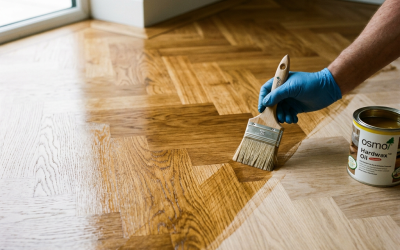
Where a hardwax-oil finish is more appropriate, particularly for certain traditional timber floors or spaces where localised maintenance is desirable, we consider products such as Osmo Polyx-Oil Anti-Slip. Its suitability depends on the actual use of the room, maintenance expectations and required slip performance. Hardwax oil should not be treated as an interchangeable substitute for a commercial polyurethane lacquer.
In entrances, corridors or other identified risk areas, we can assess whether a compatible anti-slip additive or specialist coating is appropriate. Slip resistance must be considered as part of the complete finished system, ideally supported by relevant test data and, where required, on-site pendulum testing. Adding coarse grit indiscriminately can make a surface more difficult to clean and unsuitable for certain educational activities.
Low-VOC Finishes and Chemical Safety
For nurseries, primary schools and enclosed teaching spaces, we favour finishing systems with suitable documented emissions performance. Products carrying recognised low-emission classifications such as EMICODE EC1 Plus may be considered where the specific product holds that certification. A waterborne formulation or low-VOC claim alone does not establish EC1 Plus compliance.
We examine product safety data sheets, ventilation requirements, COSHH information and the intended occupancy of the building. A coating can be touch-dry before it has achieved its specified chemical or mechanical resistance. Pupils should not be readmitted solely because the floor feels dry underfoot.
Step 5: Aftercare and Planned School Floor Maintenance
Once the finish has cured sufficiently for handover, the maintenance regime becomes part of protecting the investment. Grit at entrances behaves like sandpaper under shoes and chair legs, while unsuitable detergents can accelerate coating wear. A good maintenance plan addresses the products used by cleaners, the frequency of cleaning and which rooms are most heavily trafficked.
For lacquered school floors, routine dry removal of abrasive debris and damp cleaning with a compatible pH-neutral product are generally preferable to excessive wet mopping. Furniture should have appropriate protective feet, and entrance matting needs regular cleaning so trapped grit is not dragged further into the building. Steam cleaners, highly alkaline stripping agents and silicone-containing polishes should not be introduced without checking coating compatibility.
We recommend periodic condition reviews at doorways, corridors, dining areas and other wear points. In some cases, a professionally prepared maintenance coat can restore protection before wear reaches bare wood, saving the cost and disruption of another full sanding operation. The appropriate interval depends on actual traffic and the condition of the finish, not a fixed calendar promise.
School Floor Sanding Around Term Dates, Evenings and Weekends
Access planning often determines whether a school restoration project runs efficiently. A nursery with year-round childcare has different constraints from a secondary school that can release an assembly hall during the summer holidays. We therefore discuss working hours, site supervision, secure material storage, waste removal, emergency escape routes and planned reoccupation before agreeing the programme.
In Clapham SW4, deliveries and loading arrangements can be particularly awkward around narrow residential streets, controlled parking and busy routes near Clapham High Street, Clapham Common and Clapham North. Where premises are close to residential properties, evening work also needs consideration of noise, machine movements and any applicable local restrictions. Night-shift work is not automatically practical simply because a building is empty.
Commercial Working Arrangements
| Working Shift | Operational Benefits | Suitable Educational Facilities |
|---|---|---|
| Overnight / Out-of-Hours | Reduces interference with teaching and daytime circulation. Suitable for defined work packages where noise, ventilation and the coating’s return-to-service period allow. | Tuition centres, adult learning facilities, colleges, reception areas and selected classroom zones. |
| Weekend Phased | Allows a longer uninterrupted period for repairs, sanding, coating and initial drying. Helps avoid disturbance during the standard school week. | Primary schools, independent schools, nurseries with weekday-only operation and educational offices. |
| Sectional / Zone-by-Zone | Keeps agreed parts of the facility operational while separate areas are isolated for restoration. Requires careful management of access, dust and curing zones. | Large academies, secondary schools, university campuses, boarding schools and multi-building educational sites. |
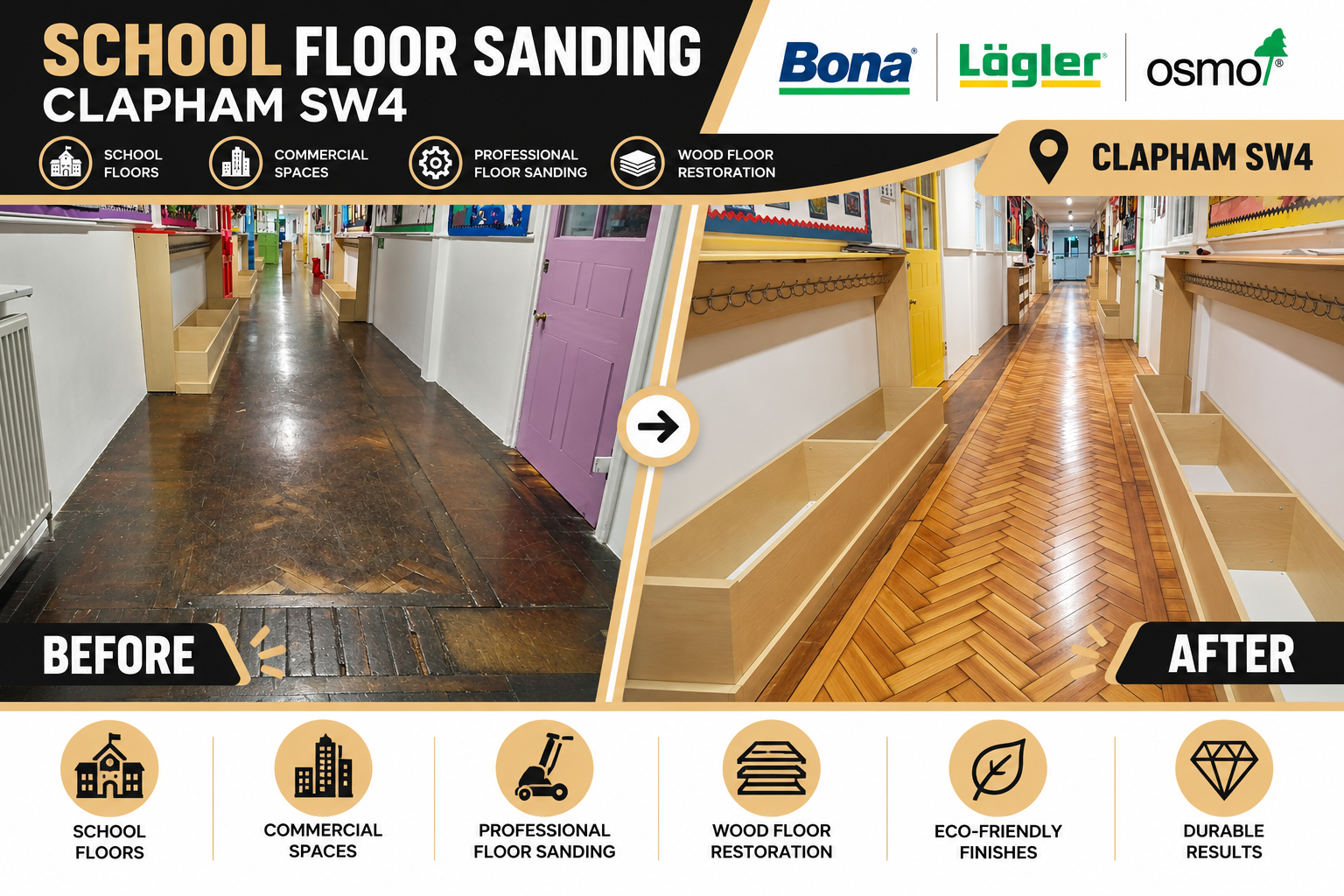
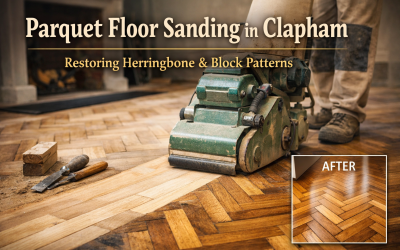
School floor sanding and restoration in Clapham, SW4. This before-and-after project showcases the transformation of a worn school corridor floor, revealing the natural warmth and character of the herringbone parquet flooring with a refreshed, polished finish. Professional wood floor restoration for schools and commercial spaces in Clapham.
How Long Before Pupils Can Use the Floor Again?
That depends on the finish, temperature, relative humidity, air movement and the type of traffic expected. Certain fast-curing 2K lacquer systems permit light use within hours and fuller traffic after approximately 12 hours under their specified conditions. Other coatings, particularly some hardwax oils, need longer drying or curing periods.
We distinguish between light foot traffic, normal school use, replacing furniture and the return of heavy wheeled equipment. Even where walking is permitted, dragging desks across a recently coated floor can mark it before full hardness develops. Damp weather and poorly ventilated rooms can also extend drying times beyond published laboratory figures.
For that reason, the written programme should identify a practical reopening point for each work zone, subject to site conditions and the selected manufacturer’s guidance. We would rather allow a sensible curing period than rush a handover and have chair marks or coating damage appearing during the first school week.
Health, Safety and Safeguarding on Occupied School Sites
Working in an educational building means following the school’s site rules as well as normal construction safety requirements. A timber floor restoration produces dust, noise, trailing equipment and temporary restricted areas, and finishing products introduce additional handling and ventilation considerations. These risks need controlling before work starts, not after the first classroom has been cleared.
A suitable project arrangement should address:
- RAMS documentation: Site-specific risk assessments and method statements covering sanding, timber repairs, coatings, access and housekeeping.
- COSHH assessments: Appropriate controls for wood dust, adhesives, hardeners, cleaning agents and finishing materials.
- Dust and respiratory protection: Suitable extraction, HEPA H14 filtration where specified, appropriate RPE and controlled access to sanding areas.
- Safeguarding: Agreed contractor access, site induction, supervision arrangements and any DBS requirements determined by the school’s safeguarding policy and applicable rules.
- Fire precautions: Safe equipment use, electrical checks and correct storage and disposal of contaminated finishing materials, especially oil-soaked cloths.
- Slip resistance: Consideration of BS EN 16165 Annex C, older BS 7976-2 specifications and the actual wet and dry conditions of use.
- Emergency arrangements: Maintaining required escape routes and separating pupils, staff and visitors from active work zones.
- Ventilation and reoccupation: Allowing appropriate drying, curing and air exchange before the affected rooms are handed back.
For projects involving a main contractor, academy trust or formal tender process, site management may request CSCS card details, evidence of relevant competency, commercial public liability insurance and subcontractor documentation. These should be checked and supplied as applicable before appointment, alongside the agreed RAMS and product information. A CSCS card alone is not proof of specialist flooring competence.
Restoring Original School Floors in Clapham SW4
One of the better reasons to restore an existing floor is that much of the original timber may still be serviceable. Around Clapham Old Town, the edges of Clapham Common and the older streets leading towards Clapham North, period properties and converted institutional buildings can contain substantial timber boards that would be expensive to replace with comparable material. Their age, however, calls for a measured approach.
Pitch pine can be resinous and may show old repairs, dark staining or nail damage. Oak parquet can suffer loose blocks and previous sanding marks, while teak and other dense hardwoods may need additional checks for coating adhesion. The finish should be selected for the specific timber and building use rather than imposed simply because it worked on another floor.
For buildings within or near conservation areas, the age and significance of original flooring may also influence the repair specification. Internal timber work does not automatically require planning permission, but listed-building controls or other restrictions can apply where historic fabric is affected. The building manager should confirm any relevant consent requirements before irreversible work takes place.
Where a school hall contains original parquet patterns or decorative borders, we aim to preserve the existing layout wherever practical. Matching timber dimensions, grain direction and species often matters more than forcing all old and new wood into an artificially uniform colour.
School Floor Sanding Prices in Clapham – What Affects the Quote?
School floor restoration is normally priced after considering the measured area, existing condition, timber repairs, selected finish and access arrangements. A clear rectangular classroom with sound boards is a different proposition from a parquet assembly hall containing loose blocks, old adhesive and multiple thresholds. Out-of-hours working, restricted loading, furniture removal and additional finishing requirements can also affect the cost.
Our published floor sanding prices provide a useful starting point, with sanding-only work advertised from £22 per square metre and sanding with clear lacquer from £25 per square metre. These are indicative starting prices, not fixed quotations for school premises. Commercial-grade coatings, repairs and special scheduling must be assessed separately.
A proper written quote should make clear what is included: preparation, sanding, repairs, gap filling, coating system, number of coats, waste handling and any agreed access restrictions. Where unforeseen defects are uncovered, additional repairs should be explained and costed before proceeding. For schools working within an approved maintenance budget, that clarity is particularly important.
Can You Restore a School Floor Without Full Sanding?
Sometimes, yes. Where the existing lacquer remains firmly bonded and the timber has not worn through to bare wood, a compatibility-checked clean, mechanical abrasion and recoat may be sufficient. This usually creates less disruption and removes less timber than a complete restoration.
Where coating adhesion has failed, water damage is widespread or the boards have become uneven, recoating over the problem is unlikely to last. We assess the condition first rather than recommend full sanding as the default answer to every worn floor.
Practical Experience, Clear Specifications and Proper Site Assessments
Clapham Floor Sanding has an established record in timber floor repair, sanding and finishing, with the company website describing more than twenty years of restoration work. The important part of a school project is matching that practical flooring knowledge to the building’s actual constraints. A good commercial specification should be understandable to the school business manager, caretaker and facilities team, not just the flooring contractor.
We recommend beginning with a photo or video assessment to establish the approximate area, floor type and visible defects. A physical site survey can then verify the construction, repair requirements, access, moisture concerns and finishing options before a firm scope of work is agreed. Commercial insurance evidence, relevant CSCS credentials and site-specific safety documents should form part of the pre-start checks where required.
You can also view our floor sanding and restoration gallery to see examples of timber floor finishes and repair work. Photographs are a useful reference for appearance, although the correct specification for your premises still depends on the existing timber and intended use.
Frequently Asked Questions About School Floor Sanding in Clapham
Can school floors be sanded during the summer holidays?
Yes. School holiday periods are often the most practical time for full sanding and restoration because classrooms can remain empty during repairs, coating and curing. We still need to account for holiday clubs, cleaning contractors, maintenance works and deliveries that may be taking place on site.
Is dust-controlled sanding safe for a working nursery?
Professional dust extraction greatly reduces airborne sanding debris, but no sanding operation should be presented as completely dust-free. In a nursery, the preferred arrangement is to isolate the work area securely and carry out dusty operations when children are absent. Access, cleaning and ventilation must be assessed before reopening.
What finish is best for a primary school classroom?
A commercial two-component waterborne polyurethane lacquer is often appropriate because of its wear resistance and straightforward routine cleaning. The exact product depends on timber condition, occupancy, maintenance practices and any slip-resistance requirements. For selected rooms, a suitable hardwax-oil system may also be considered.
Can old parquet flooring in a school hall be repaired?
In many cases, yes. Loose blocks can often be lifted, cleaned and re-bonded, and missing sections repaired with matching or compatible timber. The cause of movement or bond failure must be identified first, especially where moisture is involved.
Do school floor finishes need slip-resistance testing?
Schools must manage foreseeable slip risks, but the need for a specific pendulum test depends on the risk assessment, contract and circumstances. Where testing is specified, BS EN 16165 Annex C provides the current pendulum method, with the results interpreted for the intended conditions of use. Product claims alone should not replace an appropriate assessment of the installed floor.
How often should a school wooden floor be professionally maintained?
There is no single interval suitable for every educational building. A lightly used teaching room may retain its coating much longer than an entrance corridor or dining hall. Regular inspections and timely maintenance recoating can prevent minor wear from developing into a full sanding requirement.
Do you cover educational buildings beyond Clapham SW4?
Clapham SW4 is the main focus of this service, with enquiries also welcomed from neighbouring areas such as Battersea, Balham, Stockwell and Brixton. Access, project size and scheduling requirements can be discussed during the initial assessment.