Commercial Floor Sanding Company in Clapham SW4
Commercial timber floors in Clapham SW4 rarely wear evenly. Entrance lanes lose their lacquer first, restaurant floors collect grease and cleaning residues around service routes, school and church halls become scratched by chairs and equipment, while shop floors take concentrated wear around tills, doorways and display areas. Once the protective film has broken down, exposed timber absorbs moisture and dirt, cleaning becomes harder and the floor can develop a patchy or potentially slippery surface.
We carry out commercial floor sanding in Clapham SW4 for schools, churches, restaurants, shops, offices, community halls and other heavily used premises. Our work can include Commercial Floor Restoration in Clapham, planned Commercial Floor Maintenance in Clapham and Commercial Floor Polishing in Clapham, depending on the floor construction, remaining finish thickness and operational requirements of the building.
Clapham contains an unusually broad mix of commercial property. Around Clapham High Street there are converted 18th and 19th-century buildings alongside later Victorian and Edwardian commercial blocks, while streets around Clapham Common include substantial period properties and institutional buildings where original pitch pine, oak strip flooring and parquet can still survive beneath decades of coatings.
That variety matters. A quartersawn oak block floor cannot be treated like soft pitch pine boards, and an old teak or tropical hardwood floor often needs a different abrasive sequence and finish specification again. Before we put a machine on the timber, we establish what is actually there, how it is fixed, how much usable wear layer remains and what the building needs from the finished floor.
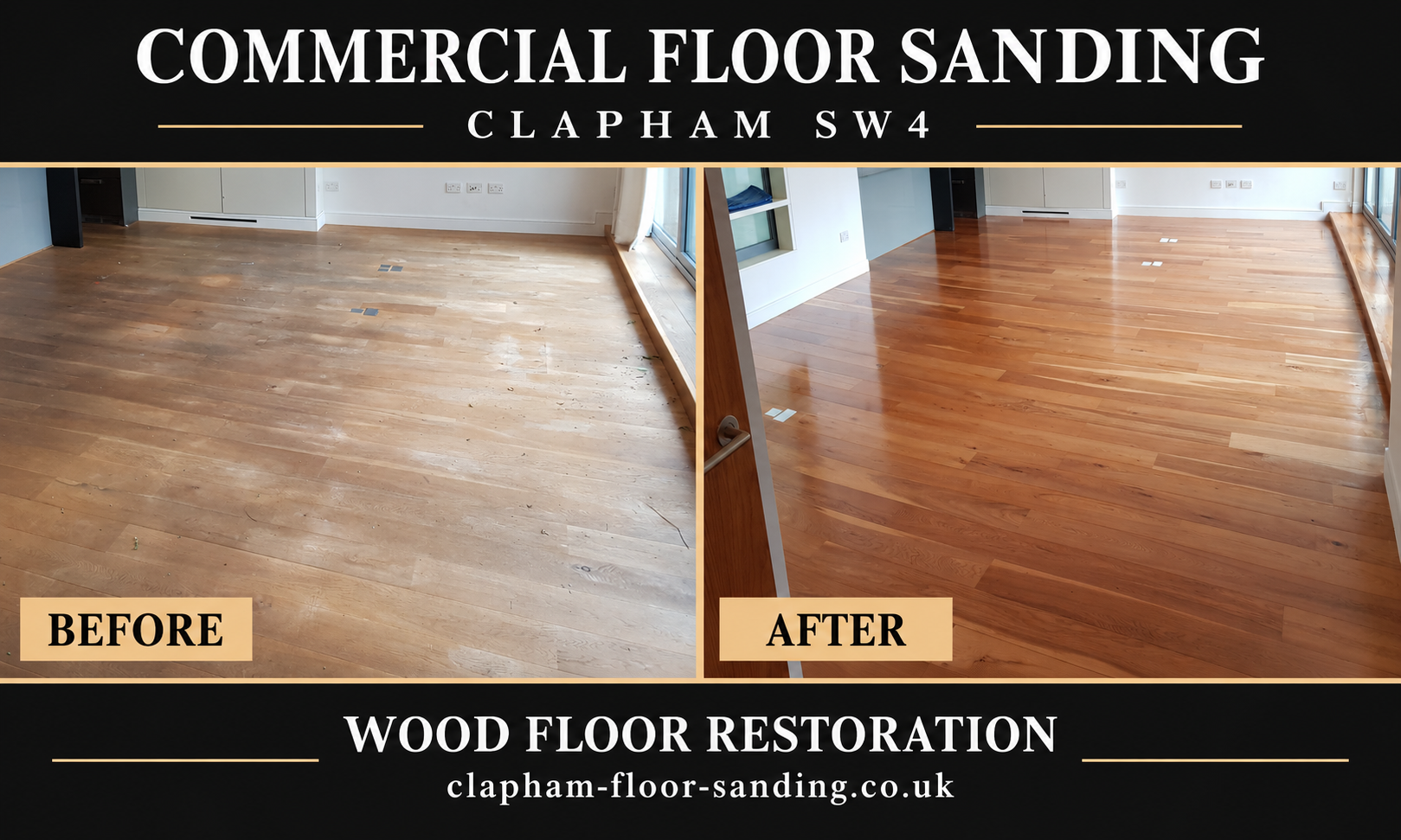
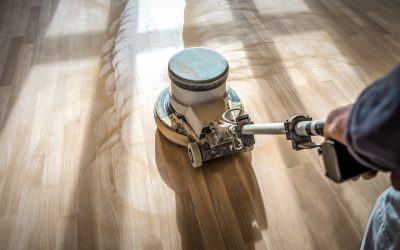
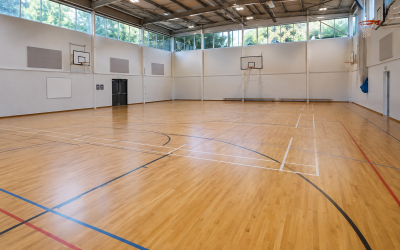
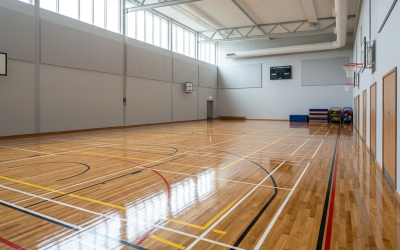
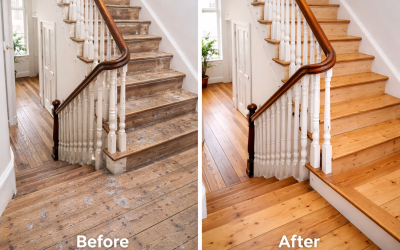
Before-and-after commercial wood floor restoration — Clapham Floor Sanding, serving Clapham SW4.
Commercial Timber Floors in Clapham Need More Than Domestic Sanding
A domestic lounge may only see a few pairs of shoes each day. A Clapham restaurant, school corridor, church hall or retail floor can take hundreds or thousands of foot movements, wheeled equipment, stacking chairs and repeated wet cleaning. That changes both the sanding specification and the finish system required afterwards.
Off-the-shelf polish cannot correct a failed coating, loose parquet or contaminated timber. Applying another product over grease, silicone, acrylic polish or degraded lacquer can simply trap the underlying problem and leave the new coating with poor adhesion.
- Open board and parquet gaps: trap dirt, cleaning water and organic debris and can enlarge as the timber moves seasonally.
- Loose parquet blocks: can move under concentrated foot traffic and damage neighbouring blocks if they are not re-bonded correctly.
- Worn entrance zones: often expose bare timber while the centre of the room still carries an old coating.
- Moisture ingress: from subfloors, entrances, leaking appliances or repeated wet cleaning can affect timber movement and coating adhesion.
- Inappropriate polish: can leave soft sacrificial films that mark under chairs and interfere with future lacquering.
- Slip performance: must be considered in public circulation areas, particularly where contamination or wet footwear is foreseeable.
- Over-sanding: can permanently damage older parquet, engineered wear layers and tongue-and-groove boards.
Where slip performance is relevant, the finish cannot be chosen on appearance alone. Pendulum testing is the recognised specialist method for evaluating floor slip resistance in the UK, with testing associated with BS 7976 methodology particularly relevant to heavily trafficked public and commercial spaces.
Our Step-by-Step Commercial Floor Restoration Process
Step 1: Subfloor Audit & Moisture Testing
The first job is inspection, not sanding. We check the floor for movement, hollow parquet blocks, failed previous repairs, projecting fixings, contaminated areas, historic water damage and changes in timber type. On engineered floors we also establish whether enough wear layer remains for another full sanding cycle.
Where moisture is suspected, hygrometer readings are taken before coating work is specified. Sanding a damp floor does not remove the moisture source, and applying a low-permeability coating before the timber and subfloor conditions are suitable can lead to cupping, edge pressure or adhesion failure.
Commercial surveys also look at how the building operates. We establish access routes, fire exits, alarm restrictions, loading arrangements, noise-sensitive hours, furniture movement and the earliest realistic time that staff, customers or pupils need the floor returned to service.
Step 2: Timber Repairs, Re-bonding & Resin Gap-Filling
Loose parquet is lifted carefully, the failed adhesive is removed and the blocks are re-bonded using a suitable modern adhesive. Where the substrate and site conditions call for it, we use flexible silane-based parquet adhesives, which accommodate limited timber movement without relying on the brittle behaviour associated with some older adhesive systems.
Missing or structurally damaged timber is matched as closely as practical for species, dimensions and age. That may mean reclaimed pitch pine boards in a Victorian building, matching oak parquet blocks in an institutional hall or compatible hardwood repairs where an old tropical timber floor is still serviceable.
Fine, stable gaps in suitable floors can be filled using a resin-slurry system mixed with clean sanding dust. Wider moving board gaps are assessed individually because rigid resin is not appropriate for every suspended timber floor; reclaimed timber slivers or a flexible filler may be the technically safer repair.
Step 3: HEPA Dust-Controlled Sanding & Surface Preparation
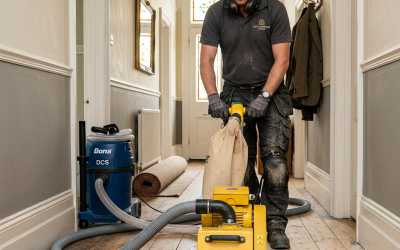
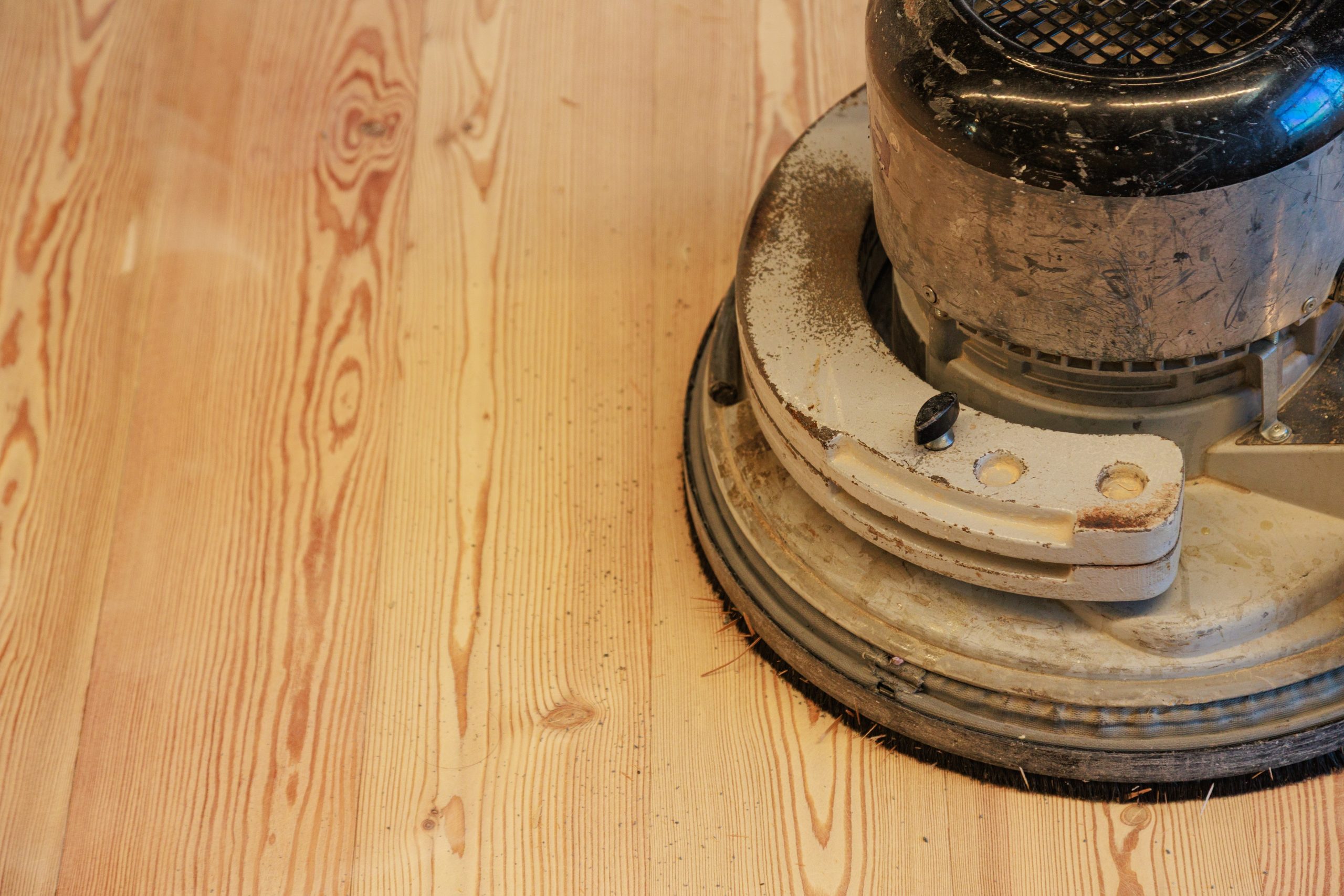
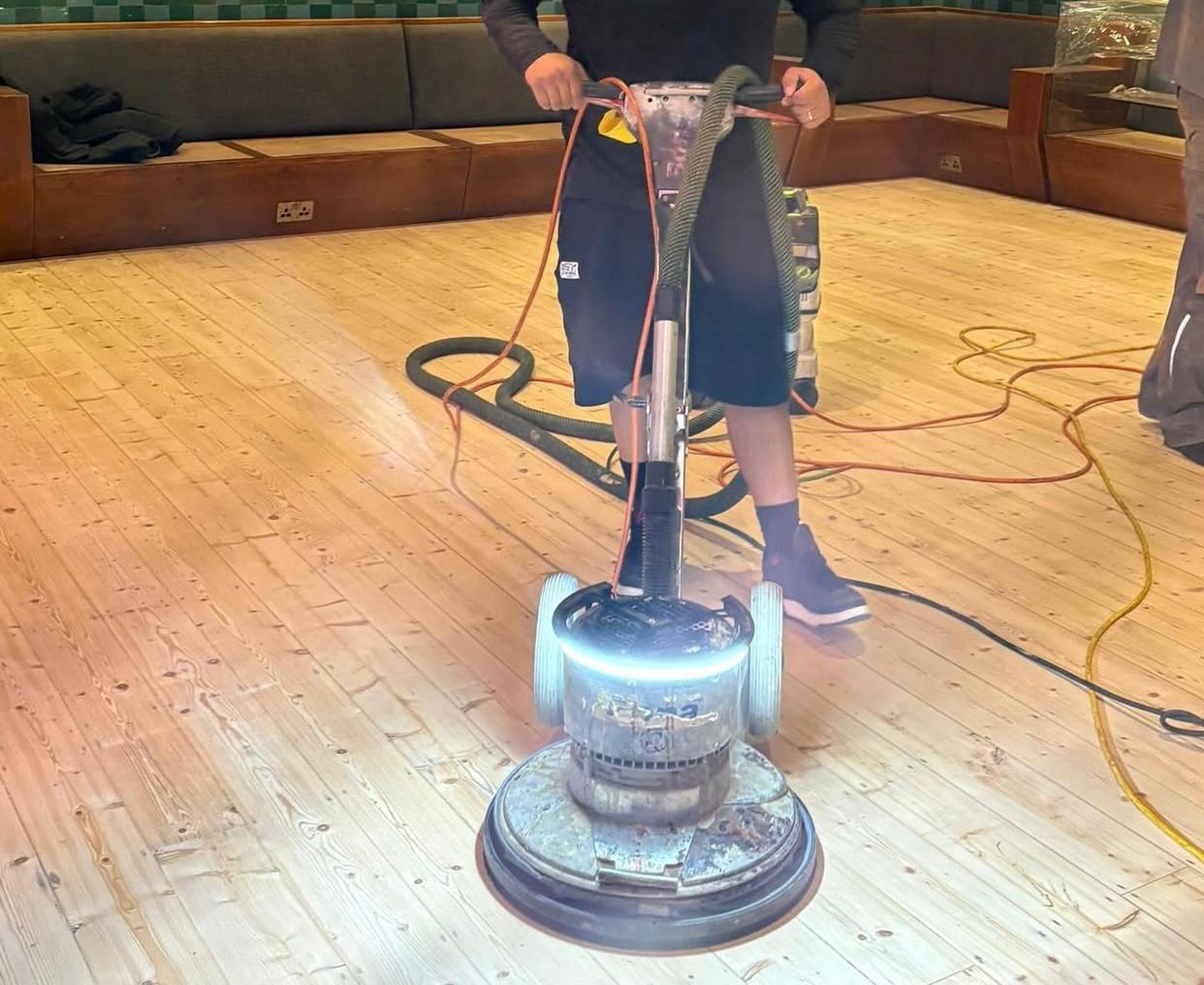
For large open areas we normally work with professional belt sanding equipment such as the Lägler Hummel, connected to high-capacity dust extraction. HEPA H14 filtration is used where the project specification calls for high-level fine-particle control, particularly in schools, healthcare-related environments, offices and occupied commercial buildings.
A typical damaged commercial floor may require a controlled abrasive progression from approximately 36 or 40 grit through intermediate cuts and finishing at 100-120 grit. We do not automatically start aggressively: old parquet, thin engineered boards and floors with uneven previous sanding may need a more conservative first cut.
Edges, door thresholds, radiator zones and corners are worked separately so the final surface remains consistent. Between abrasive stages the floor is vacuumed thoroughly because loose mineral and timber particles left beneath the next sanding pass cause unnecessary scratches.
Wood dust is a COSHH issue, not simply a housekeeping nuisance. Our commercial method planning therefore covers extraction at source, suitable respiratory protection where required, controlled waste handling and separation of the work zone from staff or public areas.
Step 4: High-Traffic Finishes – 2K Lacquers, Hardwax Oils & Anti-Slip Systems
The finish is selected according to traffic, cleaning regime and downtime. For busy shops, restaurants, educational buildings and commercial halls, we commonly specify professional 2K waterborne polyurethane lacquer systems where a hard-wearing film finish is appropriate.
These systems use a cross-linking catalyst that reacts with the coating to improve chemical and abrasion resistance compared with a basic single-component domestic lacquer. Matt and satin commercial finishes usually make more practical sense than high gloss because they show fewer minor scuffs and are easier to keep visually consistent across large floor areas.
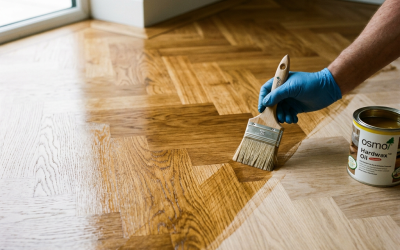
Hardwax oil can be the better specification where the client wants a more natural timber appearance or the ability to carry out localised maintenance. It is particularly useful on appropriate oak and heritage floors, although maintenance frequency needs to be planned properly in heavily trafficked premises.
Where slip risk is a design consideration, the specification can include a finish intended for improved slip resistance and, where required, independent pendulum testing. We do not describe a floor as safe merely because the coating is labelled “anti-slip”; expected contamination, cleaning practice and the actual use of the space have to be considered.
For low-emission refurbishment programmes we can also specify compatible installation and finishing products with documented VOC performance. EMICODE EC1 PLUS, where applicable to the chosen product, is a very-low-emission product classification rather than a substitute for COSHH assessment or normal site ventilation controls.
Step 5: Aftercare & Commercial Maintenance Protocols
A newly refinished floor should not be handed straight back to full commercial traffic simply because it feels dry. Waterborne coatings can become touch-dry relatively quickly while continuing to cross-link and develop resistance afterwards, so furniture replacement, entrance matting, wheeled loads and wet cleaning are phased according to the manufacturer’s cure schedule.
We provide practical handover guidance covering first access, furniture protection, cleaning chemistry and routine maintenance. Neutral wood-floor cleaners are normally preferred; concentrated alkaline detergents, steam cleaning and repeated saturation can shorten the useful life of both lacquered and oiled timber floors.
A commercial floor should also be inspected before it reaches complete coating failure. Periodic deep cleaning, machine buffing and maintenance coats can postpone another full sanding cycle and preserve valuable timber thickness.
You can review examples of previous timber restoration work in our Clapham floor sanding gallery. For current guide rates and an explanation of factors affecting project costs, see our floor sanding prices.
Working Around Active Commercial Premises in Clapham
Commercial restoration is as much about programme control as sanding technique. Clapham High Street restaurants cannot always close for a working week, schools have term dates to protect, churches have services and bookings, while shops and offices may require an entrance or circulation route to remain usable throughout the project.
For those sites we divide the floor into workable phases and plan coating windows around access requirements. Noise-producing sanding is kept within the agreed period, extraction hoses and electrical leads are managed to protect escape routes, and freshly finished sections are isolated until the coating reaches the agreed traffic stage.
| Working Shift | Operational Benefit | Typical Facility Suitability |
|---|---|---|
| Overnight | Heavy sanding and preparation carried out after public or staff access has finished, reducing daytime interference. | Retail premises, restaurants, offices, bars and selected hospitality areas. |
| Weekend Phased | Provides a longer uninterrupted sanding and coating window with additional curing time before Monday occupation. | Schools, offices, clinics, community buildings and public-facing facilities. |
| Sectional | Keeps part of a large building operational while separate zones are repaired, sanded and finished. | Large halls, multi-room premises, galleries, schools, shops and institutional buildings. |
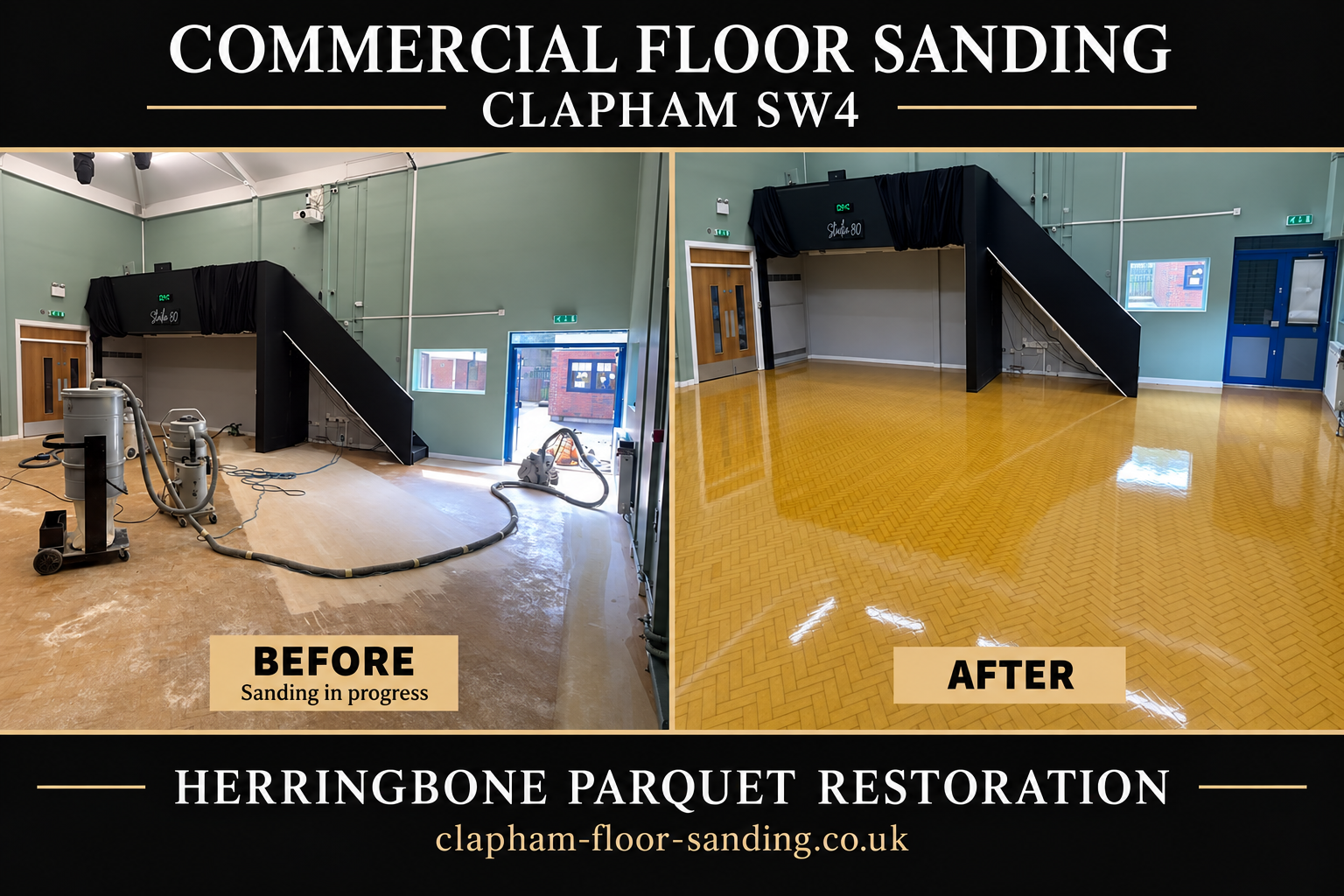
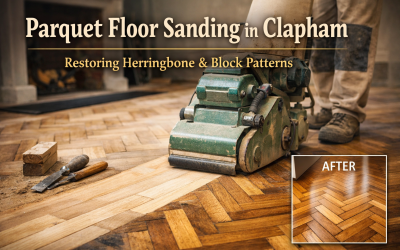
Herringbone parquet restoration, from sanding to finished floor — Clapham Floor Sanding, serving Clapham SW4.
RAMS, COSHH & Commercial Site Safety
Public and managed premises normally require more documentation than a domestic project. Our commercial planning can include RAMS documentation, task-specific risk assessments, COSHH information for coatings, fillers and cleaning products, equipment controls and agreed arrangements for keeping unauthorised people outside the working zone.
Timber sanding produces respirable and inhalable wood dust, while some coatings, adhesives and cleaning chemicals introduce separate exposure risks. Mechanical extraction, good ventilation, correct PPE and product-specific safety data sheets form part of a sensible control system rather than relying on open windows and disposable dust sheets.
On buildings with shared escape routes, the work sequence is agreed so cables, extraction equipment and temporary barriers do not compromise fire exits. In schools, churches, restaurants and community premises, the return-to-service plan also takes account of vulnerable users and the possibility of wet footwear or cleaning contamination.
Clapham Buildings Require a Building-Specific Approach
Clapham is not made up of uniform modern commercial units. The conservation area centred around Clapham Common contains numerous 18th and 19th-century buildings, while Clapham High Street records the area’s transition from residential terraces to shops and later purpose-built Victorian and Edwardian commercial premises.
That means we regularly have to think about floors as part of an older building rather than as an isolated surface. Suspended boards need ventilation below them, historic pine cannot be sanded indefinitely, old parquet may sit over substrates repaired several times, and previous black or bituminous adhesives need identification before aggressive mechanical removal is considered.
Near Clapham Common, Clapham Manor Street, Rectory Grove and the High Street, apparently similar properties can contain completely different floor constructions. Our specification is therefore based on the surveyed floor, not a standard package copied from one project to the next.
Commercial Floor Sanding for Schools, Churches, Restaurants, Shops & Halls
Schools & Educational Buildings
School halls and corridors usually suffer concentrated chair, desk and sports-equipment wear. Projects are commonly programmed during holidays or weekends, with particular attention given to dust containment, coating cure schedules and slip performance before pupils return.
Churches & Community Halls
Older halls often contain pitch pine boards, oak strip flooring or parquet that has been repeatedly coated over many decades. We retain sound original timber where possible and repair isolated damage rather than recommending unnecessary replacement.
Restaurants, Bars & Hospitality
Hospitality floors take abrasive grit from entrances, chair movement and contamination from food, oils and cleaning chemicals. Proper degreasing, removal of incompatible polish and sufficient curing time are critical if the new commercial coating is expected to stay bonded.
Shops & Retail Premises
Retail floors commonly wear first at entrances, tills and narrow traffic channels. Sectional or out-of-hours sanding can allow refurbishment to proceed without treating every square metre as though it has identical wear.
Commercial Experience, Site Documentation & Transparent Quoting
Commercial clients need more than a verbal estimate and an arrival date. Projects can be supported by CSCS-carded site operatives, appropriate commercial liability insurance documentation, RAMS and relevant product safety information according to the requirements of the premises and principal contractor.
The quotation process normally starts with photographs or a short site video. These allow us to identify obvious floor type, approximate condition, access restrictions and damage before arranging a physical survey where accurate measurements, moisture checks or closer structural inspection are required.
We then separate essential repairs, sanding, finishing and optional work rather than burying everything in an unexplained figure. Larger areas, difficult access, extensive block repairs, staining, additional finish coats and out-of-hours working can all affect the final rate.

Arrange a Commercial Floor Survey in Clapham SW4
If you manage a school, church, restaurant, shop, office, commercial hall or other premises in Clapham, send us clear photographs of the floor together with the approximate area and the dates when the building can be made available.
Floor plans, short videos and photographs of damaged sections can be sent by WhatsApp or email for an initial assessment. Where the project requires moisture testing, timber identification, extensive repairs or phased operational planning, we can then arrange a physical site survey.
Call 0800 335 7565 to discuss commercial floor sanding in Clapham SW4.
Visit Clapham Floor Sanding to request an assessment or quotation.