
How to Repair Scratches, Scuffs and Dents on Wood Floors
If your timber floor has picked up light scratches, black heel scuffs or shallow dents, the right fix depends on both the type of damage and the finish already on the floor. Minor scuffs often come off with proper cleaning, localised scratches on oiled floors are usually easier to spot-repair, and worn lacquered floors can sometimes be refreshed with a light abrasion and recoat before full sanding becomes necessary. Clapham Floor Sanding offers quotations, contact options and callback booking through its website, making it straightforward to arrange an inspection for floors in poor condition or where the finish has worn through.
Wood floors in Clapham take a fair amount of punishment. Hallways near Clapham Common, busy family kitchens, rental properties and Victorian conversions all see repeated foot traffic, chair movement and grit being walked in from outside. Before reaching for fillers, wax sticks or sanding paper, it helps to identify whether you are looking at a surface scuff, a finish scratch, a deeper gouge into bare timber, or a compression dent where the wood fibres have been pushed down rather than cut away. That distinction matters because each problem needs a different remedy if you want the repair to blend properly and last.
At Clapham Floor Sanding, we usually advise clients to start with diagnosis rather than treatment. A black scuff from rubber soles is not handled the same way as dog claw lines through lacquer, and neither should be treated like furniture dents in original pine boards. The company’s own pricing and quote pages also show that finish choice, floor condition and the extent of repairs all affect the final cost of restoration work.
What is the difference between scratches, scuffs and dents?
A lot of homeowners use these terms interchangeably, but they are not the same thing.
Scuffs
Scuffs are usually marks sitting on top of the finish, not deep damage to the timber itself. They often come from shoes, chair legs, prams or dragged items. On lacquered floors they can appear white, grey or black. On oiled floors they may look like rubbed, dull traffic marks.
Scratches
Scratches cut through some or all of the protective coating. On a lacquered floor, a scratch may show as a pale line if only the finish is damaged, or as a darker line if dirt has entered exposed wood. On an oiled floor, scratches are often more repairable because additional oil-based product can be worked into the affected section more easily. Osmo’s repair guidance specifically notes that small scratches on Polyx-Oil surfaces can be treated locally, while Bona’s homeowner and professional guidance distinguishes between wear-resistant coated surfaces and targeted maintenance of damaged areas.
Dents
Dents are compression marks where impact has pushed the timber fibres down. High heels, dropped pans, toys, furniture feet and castors are common causes. Dents can be shallow and mostly cosmetic, or deep enough to fracture finish edges and require filling or board-level repair.
First step: identify the finish on your floor
Before you attempt any repair, work out whether the floor is finished with lacquer, hardwax oil, or an older wax/oil system.
Lacquered floors
These have a sealed film sitting on top of the timber. They are common in modern domestic refinishing because they provide good wear resistance. Bona states that Bona Traffic HD is designed for high-traffic areas and offers strong resistance to wear and scuffing. When lacquer is scratched through, however, local patching can be visible if done badly because the sheen and edge blend must match. (Bona)
Oiled or hardwax-oiled floors
These penetrate and protect the wood differently. One advantage is that minor local repairs are often easier. Osmo’s maintenance guidance says small scratches can be treated locally and that care and repair paste is intended for small damage on Polyx-Oil surfaces. (Osmo)
Older waxed or site-treated floors
These may need a more cautious approach, especially on period floors in Clapham where previous coatings are inconsistent. If the finish is unknown, it is safer to test in an inconspicuous area or have a contractor inspect it before any aggressive repair.
Start with proper cleaning before assuming the floor needs sanding
Many “scratches” are actually dirt, metal transfer or rubber marking.
A correct cleaning process should include vacuuming with a soft floor head, removing grit from board joints, and then using a suitable wood floor cleaner rather than soaking the floor. Bona’s homeowner guidance for marks and furniture scratches begins with vacuuming and cleaning the area before any restorative product is applied, while Osmo also advises cleaning and dust removal before attempting scratch repair.
That matters in real homes because grit left on the surface keeps abrading the finish, especially in entrances and living areas. In Clapham terraces and flats, where people are often moving between the street, garden and kitchen, repeat abrasion is one of the biggest reasons otherwise good floors start to look tired.
How to deal with light scuffs on wood floors
For light scuffs that sit in the finish only:
- Vacuum the area thoroughly.
- Clean it with a wood-floor-safe cleaner.
- Buff gently with a microfibre cloth or pad.
- Reassess under good natural light.
On an oiled floor, a maintenance product may restore the surface if the mark has also dulled the sheen. On lacquered floors, superficial scuffing across wider traffic lanes may indicate that the coating is wearing thin and would benefit from a maintenance coat rather than repeated DIY rubbing.
If the scuff disappears after cleaning, the timber is fine. If the mark remains but has not broken through the finish, a local buff or maintenance product may be enough. If you can catch a fingernail in it, it is no longer just a scuff.
How to handle shallow scratches
Shallow scratches are the most common domestic problem and the correct repair depends on finish type.
On hardwax-oiled floors
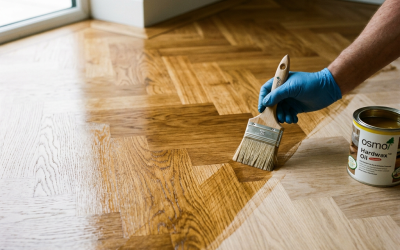
These are often the most forgiving. Osmo advises cleaning first, smoothing raised fibres where needed, and then applying a repair product thinly to the affected area, allowing appropriate drying time. Their wider technical guidance also notes that small scratches can be re-oiled locally.
In practice, that means a professional can often:
- clean and decontaminate the scratch,
- very lightly abrade the affected zone,
- reapply compatible hardwax oil,
- feather the repair into the surrounding boards.
This is one reason many homeowners like hardwax oil in family houses: future spot maintenance is often more manageable.
On lacquered floors
Shallow scratches in lacquer are more awkward. A DIY touch-up may reduce visibility, but patching can leave flashing or sheen variation. Where scratching is widespread rather than isolated, a screen and recoat is usually the neater answer. Bona’s professional finish guidance highlights high wear resistance in Traffic HD, and third-party guidance on recoating lacquered wood floors explains that cleaning, superficial abrasion and a fresh topcoat can revive a worn surface without full sanding when the coating is still fundamentally sound.
That is often the sweet spot for Clapham households where the finish is scratched but the boards themselves are not yet deeply damaged.
What to do about deeper scratches and gouges
Once a scratch has gone through the finish and into the timber, the repair becomes more technical.
A proper professional approach may involve:
- checking whether the exposed wood has darkened from contamination,
- cleaning out embedded dirt,
- localised sanding through a controlled grit sequence,
- colour matching if the timber has aged,
- filling where material is missing,
- recoating or re-oiling the repaired section.
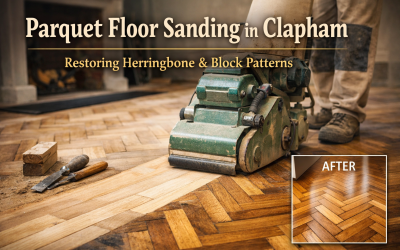
This is especially relevant on old pine boards, where ambering and historic oxidation mean fresh exposed timber can look much lighter than the surrounding floor. On parquet, repairs can be even more visible if the damaged block sits within a pattern or if the sheen level changes from one block to the next.
For floors with multiple deep scratches across a room, isolated patch repairs can quickly become false economy. At that stage, a full sand and refinish often gives the better visual result.
You can direct users to service and booking pages naturally throughout the article, for example:
- wood floor sanding in Clapham
- request a callback for floor repairs
- get a quote for floor restoration
Those links align well with the live site structure.
How to deal with dents in timber floors
Dents are different because the wood has been compressed rather than removed.
Minor compression dents
If the finish is intact and the dent is shallow, the issue may be mostly cosmetic. Some older site-finished floors show these as character marks rather than defects.
Dents with broken finish
If the impact has cracked lacquer or torn the fibres, moisture and dirt can enter. That is where the problem escalates from “looks untidy” to “needs repair”.
Deeper dents in softwood
Victorian pine and other softer boards dent far more easily than oak. In Clapham’s older housing stock, it is common to see impact damage around fireplaces, hall runners, dining tables and old cast-iron furniture.
Professional repair options include:
- local filling and colour blending,
- board-level piecing-in,
- sanding and refinishing the affected board group,
- full room sanding where damage is extensive.
Steam lifting is sometimes discussed online, but it is not a universal fix and can make matters worse on finished floors by whitening coatings, raising grain or disturbing fillers. On already-coated domestic floors, it is generally better to assess finish type first rather than trying improvised moisture-based dent lifting.
When a maintenance coat is enough
Not every marked floor needs to be sanded back to bare wood.
If the boards are flat, stable and free from heavy black staining, a maintenance coat may be the best-value option when:
- the damage is mostly surface scuffing,
- scratches are widespread but not deep,
- the existing lacquer is worn rather than failing,
- the client wants to improve appearance and add protection without full disruption.
Bona’s recoat guidance and Traffic HD product information support this middle-ground approach where the finish system is still suitable for overcoating after proper preparation.
This is a strong recommendation for busy homes where you want to restore clarity and durability before deeper wear develops.
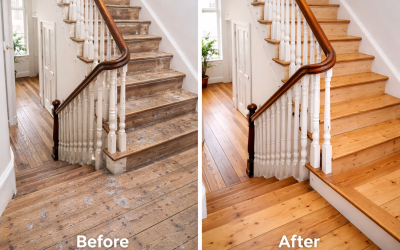
When you need full sanding and refinishing
A full sand is usually the right answer when:
- scratches have gone through the finish across large areas,
- dents and gouges are numerous,
- there are black water marks or deep contamination,
- old coatings are patchy or failing,
- previous spot repairs are obvious,
- the floor is uneven in sheen or colour.
Clapham Floor Sanding’s pricing page makes clear that the condition of the floor and the amount of preparation required affect the overall project scope and cost. That reflects real trade practice: damaged floors take longer because prep is everything.
A full professional refinish also gives you the chance to correct other defects at the same time:
- gap filling,
- minor board repairs,
- edge detail work,
- finish upgrade to lacquer or hardwax oil,
- improved slip, wear and cleanability characteristics.
The best way to prevent new scratches and dents
Repairing a timber floor properly matters, but prevention saves money.
Use felt pads
Dining chairs are one of the worst causes of repeated finish scratching.
Control grit at entrances
A surprising amount of visible scratching comes from fine grit under shoes. Entrance mats reduce abrasive wear dramatically.
Avoid hard plastic castors
Use protective chair mats or change wheel types where possible.
Lift, don’t drag
Furniture should be lifted rather than pulled across the floor.
Match maintenance to finish type
Oiled floors and lacquered floors need different care products and repair strategies. Using the wrong cleaner can dull the surface or leave residues.
Recoat before the finish fails
Once traffic lanes wear through completely, the timber itself becomes vulnerable. Recoating earlier is often cheaper than late-stage restoration.
Why local repair advice matters in Clapham
Clapham homes are a mix of Victorian, Edwardian and more modern interiors, and wood floor damage behaves differently in each.
In older properties, you may be dealing with:
- softer original pine,
- historic movement,
- old patch repairs,
- previous stains or shellac residues,
- uneven colour from sunlight and rugs.
In newer homes, the issue is often prefinished engineered boards where the wear layer is limited and aggressive sanding is not always appropriate.
That is why generic internet advice can be misleading. The right answer is not just “sand it” or “use a touch-up pen”. It depends on timber species, board age, finish type, traffic pattern and how visible the affected section is in the room.
For homeowners deciding between repair and replacement, a local inspection is usually the fastest route. Clapham Floor Sanding provides direct contact, callback and quote forms, along with a gallery and blog section that can support trust-building and service enquiries.
Final advice
Scratches, scuffs and dents do not all need the same treatment. Some marks need only careful cleaning. Others need a localised repair. Some lacquered floors can be refreshed with a maintenance coat, while heavily worn or deeply damaged boards need a full sand and refinish.
The main mistake homeowners make is attempting a quick cosmetic fix without first identifying the finish. That often creates a second problem: patchy sheen, mismatched colour or unnecessary sanding.
If your floor in Clapham is showing isolated wear, early intervention is usually the best-value route. And if the damage is spread across entrances, kitchens, hallways or living spaces, it is worth arranging a proper assessment through the site’s home page, quote form or contact page.